
Key points:
-
Researchers successfully tested a technique that uses human sewage to measure the use of nicotine products such as cigarettes and vaping pens in a selected community.
-
The project, led by scientists at UC Merced, can strengthen public health efforts by supplementing surveys about nicotine use with scientific data.
-
The research targeted a handful of Central Valley communities. Scientists hope to expand it to other California locations.
UC Merced researchers successfully measured nicotine use from products such as cigarettes and vaping pens in Central Valley communities, confirming that health education can be backed by hard data from an unusual source: human waste.
An analysis of wastewater in three counties, along with UC Merced’s sewage system, was a significant step in a long-range plan to extend testing to other locations in California. The research is led by Professor Colleen Naughton with support from UC Merced’s Nicotine and Cannabis Policy Center (NCPC) and Health Sciences Research Institute.
“To our knowledge, this was the first use of this technology in California for monitoring nicotine,” said Naughton, a member of the Department of Civil and Environmental Engineering. A department colleague, Professor Marc Beutel, is working alongside Naughton on the project.
NCPC is funded by the Tobacco-Related Disease Research Program, administered by the University of California Office of the President.
Tobacco is a significant health concern in the Valley’s rural areas. The federal Centers for Disease Control reported that 9.9% of the overall U.S. adult population smoked cigarettes in 2024, but the percentage jumps to about 16% in “non-metropolitan” areas.
Traditional methods of collecting information about nicotine use, such as surveys and phone calls, suffer from low response rates and difficulties in connecting with hard-to-contact populations. In addition, answers to questions such as “do you smoke, and how much?” can be subjective or inaccurate.
The science of wastewater epidemiology treats a sewage system like a health screening tool, scanning for microscopic chemical signatures, or biomarkers, shed by humans. The technique gained attention during the COVID-19 pandemic, with community infections sometimes detected before hospitalizations spiked. Naughton’s lab developed an award-winning online dashboard that tracked wastewater testing for the virus around the globe.
 To detect tobacco use, the technique looks for chemicals in body excretions, mostly urine, after the liver metabolizes nicotine. Naughton said the tests can tell the difference between nicotine that passed through a person versus, say, an ashtray’s contents dumped into a toilet.
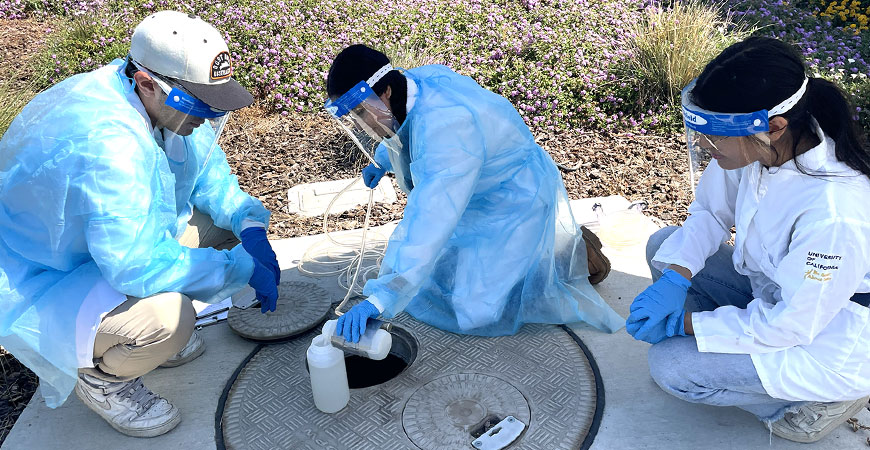
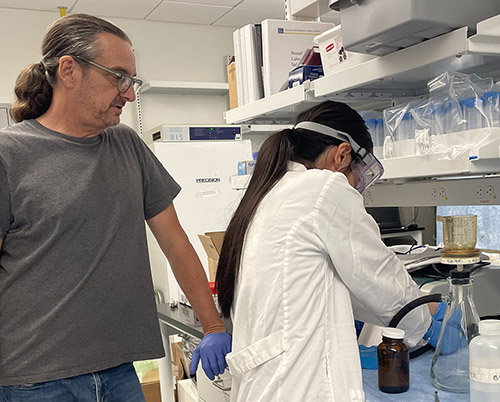
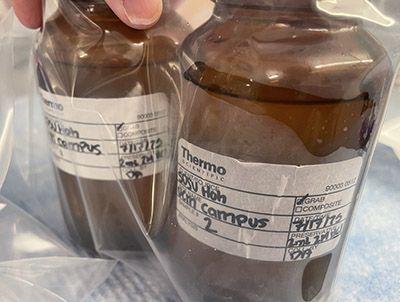
Naughton’s team took samples from wastewater at UC Merced and at treatment plants in Merced, Modesto and Woodland (Yolo County) from July through December 2025. Samples were sent to San Diego State University. There, a team led by environmental health Professor Euhna Hoh analyzed them with a mass spectrometer, a highly sensitive instrument that can weigh and count at the molecular level.
The spectrometer is so sensitive that UC Merced student researchers were trained to ensure they had no secondhand smoke in their clothing, as even a microscopic trace could ruin a sample.
Some results:
-
Not surprisingly, UC Merced, which operates as a smoke-free campus, had lower nicotine concentrations than the three communities. Naughton said there was a bump in levels during late-October midterm tests. A spike in student stress, perhaps?
-
Total nicotine consumption data were similar in the three municipal wastewater treatment plants. The data, together with census numbers, could be seen to indicate Merced smokers light up nearly twice as often as those in Modesto and Woodland. Naughton, however, stressed the data alone can’t drill down to individual habits. “It’s a population sample of thousands of people,” she said. “It’s about trends.”
She said she and her team intend to improve the ability to differentiate cigarette use from vaping, which generates mist instead of smoke. The researchers are also aware of emerging products such as nicotine pouches, which may increase nicotine consumption.
“In the Central Valley, where we have underserved populations and a shortage of healthcare, smoking causes so many problems, like heart and lung disease,” Naughton said. “So this is an important tool we can use to help those populations.”
